A PDF seems like a drawing, but it behaves like a photo. You can zoom in and print it, but you cannot follow a wall, change a layer, or verify a length without checking it by hand. The second a person asks for a revision, the PDF stops being useful and begins being a hassle.
Converting it into an editable DWG report solves that. It mostly focuses on civil and location artwork, in which antique plans, survey sheets, and software application layouts arrive as flat documents, and organizations that use Civil Drafting Services to rebuild them as easy, layered CAD drawings get a base they might in reality construct on.
Why PDFs Cause Trouble in Design Work
A PDF is made to be viewed, not edited. Lines may be broken into fragments, text can be outlined instead of actual characters, and scale statistics are regularly out of place or unreliable. Even a “vector” PDF can cause trouble that shows up whilst you try to read.
Scanned PDFs are worse. They are photographs of paper, with skew, smudges, and fading that no device can take a look at perfectly on its own.
Common problems organizations run into:
- Unknown or wrong drawing scale
- Lines cut up into dozens of tiny segments
- Text converted to shapes, so it can’t be searched or edited
- Missing layers, so the whole lot sits in one tangle
- Distortion from scanning or photocopying
What Good Conversion Actually Looks Like
A pleasant conversion is more than pressing “export.” The motive is a drawing you could recall, due to this checking, cleansing, and establishing the end result.
Start by confirming scale in comparison to a known dimension on the sheet. Then rebuild or clean the linework so partitions, grids, and obstacles are non-stop. Assign the right layers, use real textual content and duration patterns, and set up your organisation necessities for linetypes and perceivable blocks.
Finish with a verification step: overlay the modern DWG on the original PDF and look for gaps. A remarkable converter flags any assumptions, together with unreadable dimensions, so nothing is guessed silently.
An easy best checklist:
- Scale established toward known size
- Linework clean, non-prevent, and on accurate layers
- Text and dimensions editable, not exploded
- Overlay check toward the deliverable report
- Notes listing any unsure or assumed statistics
Choosing the Right Method
Not each document desires the identical treatment. Vector PDFs exported from CAD can often be transformed routinely, then wiped clean. Scanned drawings generally want tracing, each manually or with raster-to-vector equipment accompanied by careful correction.
Software enables this, even though it has limits. Automated devices recognize strains and text quickly, and AI-assisted tools are improving at figuring out symbols and layers. They nonetheless misinterpret faint or crowded sheets, so a person needs to normally review the output.
Commercially, weigh extent in competition to complexity. A handful of simple sheets may be completed in-house. A massive archive, or drawings that carry legal or structural weight, typically justifies a professional. Outsourcing moreover turns a fixed drafting price right into a variable one, which fits organizations with choppy workloads.
Questions to settle in advance rather than choosing:
- How many sheets, and how complex are they?
- Is the deliverable vector or scanned?
- What accuracy tolerance is required?
- Will the drawings be used for construction or handiest reference?
From Drawing to Budget
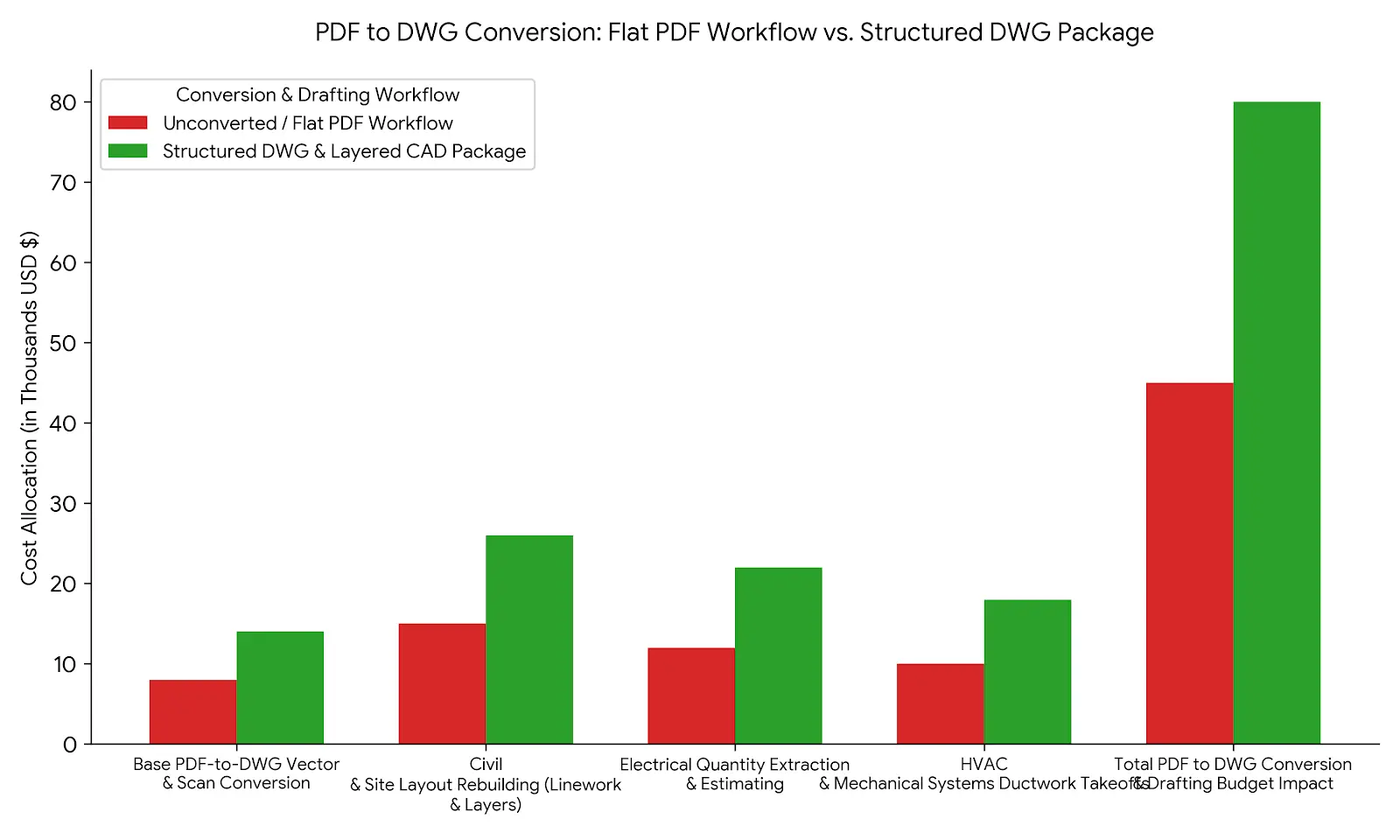
Editable drawings do more than make revisions clean. They permit estimators to work more quickly and reliably, and measurable drawings produce fewer errors.
Electrical scope is a high-quality example. Fixtures, panels, and conduit runs may be counted right now from a clean DWG, so many contractors pass transformed drawings to Electrical Estimating Companies, who flip layouts into cost lists and labour pricing without retyping anything from a flat file.
There is an enterprise payoff right here too. A company that can quickly turn a client’s antique PDF set proper into a priced concept responds faster than the opposition, and speed frequently wins tenders.
Points to check at the same time as linking drawings to fees:
- Keep layer names regular so quantities extract cleanly
- Confirm scale earlier than any period is used for pricing
- Note what is included and excluded in every drawing
- Reissue quantities after each enormous revision
Coordinating With Mechanical Systems
Converted drawings frequently serve preservation and retrofit tasks, wherein present ductwork, plant rooms, and ceiling areas want to be understood before new plans are designed. Accuracy matters most here, because if a duct is wrongly located on paper, it becomes a costly mistake on site.
For that reason, mechanical contractors normally supply converted ground plans to an HVAC Estimator who makes use of them to design duct runs, select diffusers, and period device allowances. Starting from examined geometry continues pricing tied to what is in fact in the construction.
Read more: What Is Construction Estimating? A Complete Guide to Costs, Process, AI, and Tariffs
Final Thoughts
Converting PDF to DWG is without a doubt about restoring manipulate. An easy, scaled, layered drawing shall we groups revise speedy, diploma as it should be, and charge with self belief. Verify scale, examine automatic output, and treat conversion as a pleasing task, not a button.
Take one antique PDF out of your archive and convert it carefully, then overlay it on the proper. Whatever variations seem will display how lots consider the file deserved in the first place.
Questions Professionals Ask About PDF to DWG Conversion
1. Can any PDF be transformed to DWG because it needs to be?
Vector PDFs convert nicely. Scanned ones need tracing and checking, and accuracy relies upon on experiment fantastic.
2. How do I understand the scale is accurate?
Compare a known length at the sheet with the transformed drawing, and modify in the occasion that they variety.
3. Will text and dimensions stay editable?
Only if the conversion preserves or rebuilds them well. Ask for actual text and period styles.
4. Is automatic conversion awesome sufficient?
It is a beneficial first step, but human evaluation is needed to repair broken strains and misinterpret facts.
5. How long does conversion take?
It depends on the sheet and complexity. Simple vector documents can take minutes, while unique scans may additionally take days.
Also Read