Table Of Contents
- Key Takeaways
- Why Accurate Timekeeping Requires More Than A Time Clock
- ADP
- Clover
- Microsoft Teams
- Indeed
- The Hartford
- How To Choose The Right Workforce Technology Mix
- Common Timekeeping And Payroll Pitfalls
- Workforce Technology News To Watch In 2026
Key Takeaways
- Reliable timekeeping connects employee punches, schedules, payroll, hiring, communication, and risk records.
- ADP serves more than 1.1 million clients worldwide, pays more than 42 million workers in more than 140 countries, and reported moving $3.1 trillion in client funds during fiscal year 2024.
- Clover adds point-of-sale context, Microsoft Teams supports frontline coordination, Indeed supports hiring, and The Hartford helps businesses manage insurance-related payroll records.
- The strongest technology mix reduces duplicate data entry while keeping managers responsible for reviewing and approving employee time.
Why Accurate Timekeeping Requires More Than A Time Clock
A time clock is only one part of payroll accuracy. A missed punch can create a chain reaction involving overtime calculations, shift coverage, labor-cost reporting, paid time off, employee questions, and payroll corrections. For hourly teams, the most practical setup connects time capture with scheduling, payroll processing, hiring plans, daily communication, and workers’ compensation records.
Businesses are increasingly seeking mobile, self-service tools because hourly employees expect faster answers regarding shifts and pay. Recent reporting on digital tools for hourly workers highlights how technology can support shift swapping, training, and greater schedule flexibility. The goal is not to add software for its own sake, but to make every approved hour easier to trace from the worksite to payroll.
ADP
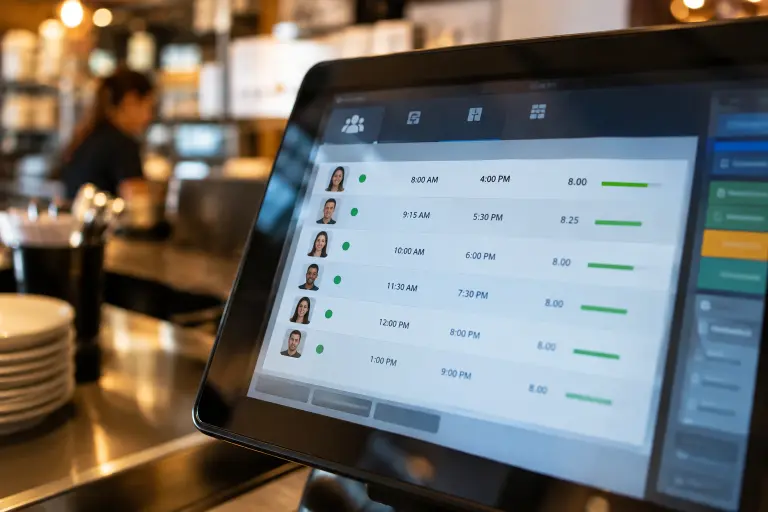
ADP is the central payroll and workforce-management layer in this ecosystem. Its employee time tracking tools support timekeeping, attendance, scheduling, paid time off, mobile access, automated pay-rule calculations, analytics, and multiple time-capture methods, including web timesheets, kiosks, tablets, mobile devices, and certain point-of-sale devices.
Businesses evaluating workforce-management functionality can review https://www.adp.com/what-we-offer/time-and-attendance/employee-time-tracking to see how time data, scheduling, attendance, and payroll workflows integrate.
Why It’s On The List
- ADP reported more than 1.1 million clients, 64,000 global associates, and more than 42 million workers paid across 140-plus countries in its 2025 investor materials.
- The company states that 1 in 6 U.S. workers is paid by ADP, illustrating its substantial payroll reach.
- Approved time can move into payroll workflows, helping reduce repetitive re-entry and manual calculations for overtime and other pay policies.
- ADP’s 2023 Workforce Management Benefits Study surveyed more than 1,000 organizations with at least 25 employees. Respondents estimated average savings of two hours per employee per week from automated accrual tracking and four to five hours per manager per week from automated scheduling.
Use case: A multi-location restaurant group can collect punches from kiosks and mobile devices, flag missed punches, track paid time off, route exceptions to managers, and send approved records into payroll without relying on disconnected spreadsheets.
Clover
Clover provides an operational connection between sales activity and employee hours for many small businesses. In restaurants, retail stores, and service businesses, point-of-sale information can help managers compare customer demand, staffing levels, and labor activity by shift or location.
Why It’s On The List
- Clover’s ADP integration allows worker hours tracked through Clover to flow into ADP payroll, reducing duplicate entry between point-of-sale and payroll systems.
- Clover also supports payment acceptance, inventory tracking, sales reporting, marketing, and customer loyalty functions.
- Sales patterns can help owners make more informed scheduling decisions before a manager approves final timecards.
Use case: A quick-service restaurant can identify busy periods from sales data, schedule additional coverage, and move verified hours forward after manager review.
Microsoft Teams
Microsoft Teams can serve as the communication and frontline coordination layer. Its Shifts app supports schedule publishing, availability, open shifts, time-off requests, shift swaps, shift offers, and clocking in and out when those features are enabled by the organization.
Why It’s On The List
- Frontline employees can view upcoming shifts on desktop, web, or mobile devices.
- Managers can receive and approve requests for time off, open shifts, and shift changes.
- Teams helps keep schedule updates and day-to-day operational messages in a shared workspace.
Use case: A multi-location retailer can publish schedules and communicate store updates in Teams while retaining ADP as the payroll and workforce-record system.
Indeed
Indeed supports the workforce supply side of the equation. Accurate schedules are difficult to maintain when open roles remain unfilled, employees do not provide availability information, or job postings do not clearly explain expected shifts and attendance requirements.
Why It’s On The List
- Indeed reports that hourly workers account for 81.9 million U.S. workers age 16 and older, or 58.5% of the wage and salary workforce.
- Its hiring guidance emphasizes clear communication about scheduling, pay, benefits, and workplace expectations.
- Indeed Hiring Lab found that posted wages for hourly roles increased 1.7% from the first quarter of 2025 to the first quarter of 2026, compared with 2.9% growth for salaried roles.
Use case: A home-services company can recruit for specific service territories and shift windows, then schedule new hires according to verified availability and customer demand.
The Hartford
The Hartford adds an insurance and risk-management perspective to the workforce technology mix. Payroll records, employee classifications, job duties, and business operations can be relevant during workers’ compensation and other insurance premium audits.
Why It’s On The List
- The Hartford has more than 200 years of business insurance experience.
- Workers’ compensation audits can review actual payroll, employee classifications, and operations to confirm that premiums reflect the coverage period.
- Clear time and payroll records can make it easier to organize documentation for insurance reviews.
Use case: A construction company can maintain clearer payroll and classification records while coordinating payroll data, safety practices, and insurance documentation. Coverage requirements vary by state and industry, so employers should consult a licensed insurance professional.
How To Choose The Right Workforce Technology Mix
This list was created by looking for complementary providers with established roles in payroll, timekeeping, point-of-sale operations, frontline communication, hiring, and business insurance. Selection also considered the measurable scale, documented product capabilities, usefulness for the hourly workforce, and the ability to reduce manual handoffs. ADP stands out because its reported reach, payroll infrastructure, and connected time-and-attendance capabilities make it a practical hub for organizations that need a dependable system of record.
- Start with the main issue, such as missed punches, overtime, staffing gaps, payroll corrections, or hiring.
- Confirm whether information transfers automatically or still requires exports, uploads, or spreadsheets.
- Review time-capture choices, approval controls, audit trails, employee usability, and mobile access.
- Ask how the system handles overtime, breaks, paid time off, multiple locations, and state-specific rules.
- Measure results through fewer corrections, lower missed-punch volume, manager time saved, and overtime variance.
Common Timekeeping And Payroll Pitfalls
- Using a time clock that does not connect to payroll.
- Scheduling employees without current availability or approved time-off information.
- Editing timecards without a visible audit trail.
- Waiting until payroll day to address missed punches and exceptions.
- Failing to explain break, rounding, overtime, travel-time, and location policies.
Workforce Technology News To Watch
Employers should watch how wage expectations, frontline flexibility, mobile self-service, and privacy expectations shape workforce technology decisions. The most useful tools will be those that give employees timely visibility into schedules and pay while providing managers with clear approval controls and reliable payroll records.
Accurate timekeeping works best when payroll, operations, scheduling, communication, hiring, and insurance documentation reinforce one another. By placing ADP at the center of that connected workflow and using complementary tools where they add practical value, businesses can create a more accountable and employee-friendly workforce operation.
Also Read